
Overview
Wound healing is a complex, multi-phase biological process encompassing haemostasis, inflammation, proliferation, and extracellular matrix remodelling. Endogenous and synthetic peptides participate in signalling pathways across all four phases, making wound repair one of the most active areas of preclinical peptide research.
| Phase | Timeframe (Typical) | Key Processes | Peptides Investigated |
|---|---|---|---|
| Haemostasis | 0–6 hours | Vasoconstriction, platelet aggregation, fibrin clot formation | Thrombin-derived peptides, PDGF |
| Inflammatory | 0–3 days | Neutrophil/macrophage infiltration, debridement | BPC-157, anti-inflammatory peptides |
| Proliferative | 3–14 days | Angiogenesis, fibroplasia, re-epithelialization | Thymosin beta-4, TB-500 (synthetic fragment), GHK-Cu |
| Remodelling | 14 days – 12+ months | Collagen cross-linking, matrix maturation | GHK-Cu, structural collagen peptides |
BPC-157 in Tissue Repair Research
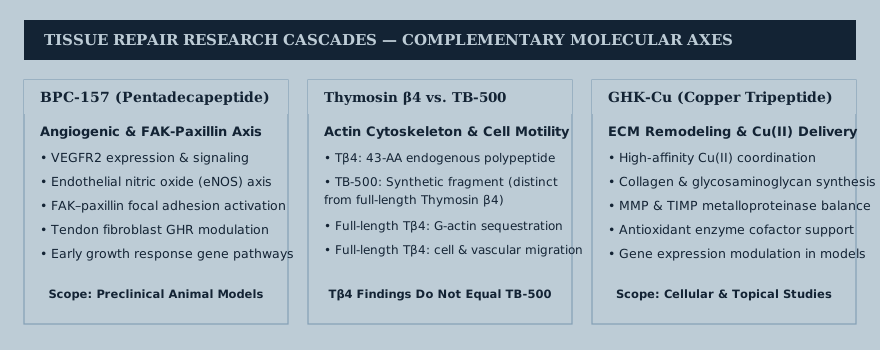
BPC-157 (Body Protection Compound-157) is a 15-amino-acid synthetic peptide derived from human gastric juice that has been extensively investigated in rodent models of tendon, ligament, muscle, gastrointestinal, and cutaneous wound healing.
Published preclinical research has documented accelerated tendon-to-bone healing, increased fibroblast migration and proliferation in vitro, upregulation of growth hormone receptor expression on tendon fibroblasts, and modulation of the nitric oxide (NO) and vascular endothelial growth factor (VEGF) pathways. Immunohistochemical readouts in BPC-157 wound models frequently include Ki-67 and PCNA cellular proliferation indices.
TB-500 (Thymosin Beta-4 Fragment) in Tissue Repair Research
TB-500 (Ac-LKKTETQ) is a short synthetic peptide fragment modelled on the active actin-binding domain of thymosin beta-4 (Tβ4), a 43-amino-acid protein present in platelets, wound fluid, and most mammalian nucleated cells. TB-500 is not full-length thymosin beta-4; findings about full-length thymosin beta-4 do not establish the same findings for TB-500.
Peer-reviewed publications on full-length 43-residue thymosin beta-4 (and, in separate structure-function assays, synthetic 7-residue LKKTETQ actin-binding fragments) have examined endothelial cell migration and capillary tube formation, keratinocyte and fibroblast migration in scratch-wound assays, pro-inflammatory cytokine modulation in injured tissue models, and dermal and corneal wound closure rates in rodent models; experimental results obtained with intact 43-residue thymosin beta-4 should not be conflated with those of the synthetic heptapeptide fragment TB-500.
GHK-Cu in Matrix Remodelling Research
GHK-Cu (glycyl-L-histidyl-L-lysine:copper(II)) is a naturally occurring copper-binding tripeptide first isolated from human plasma. In wound healing and skin biology research, GHK-Cu has been studied for its influence on collagen, elastin, and glycosaminoglycan synthesis in dermal fibroblasts, regulation of matrix metalloproteinases (MMPs) and their tissue inhibitors (TIMPs), chemoattraction of repair cells to injury sites, and modulation of antioxidant defense genes (SOD, catalase pathways).
Research Design Considerations
Researchers designing wound healing experiments with peptides may consult our dosing guidelines, combination protocol reference, and safety and monitoring documentation for methodological context.
Wound Healing Endpoint Reference
The following table summarizes standard quantitative endpoints used across published preclinical wound healing peptide studies:
| Phase | Primary Endpoint | Analytical Method |
|---|---|---|
| Haemostasis | Bleeding time, clot formation | Tail-clip assay; thromboelastography |
| Inflammatory | Neutrophil/macrophage infiltration | Myeloperoxidase activity; F4/80 IHC |
| Inflammatory | Cytokine expression | Multiplex ELISA (IL-6, TNF-α, IL-10) |
| Proliferative | Cell proliferation | Ki-67 and PCNA IHC; BrdU incorporation |
| Proliferative | Angiogenesis | CD31 / vWF microvascular density |
| Proliferative | Re-epithelialization | Wound area planimetry over time |
| Remodelling | Collagen organization | Sirius red polarization microscopy |
| Remodelling | Tensile strength | Tensometry of repaired tissue |
| Remodelling | Matrix metalloproteinase activity | Gelatin zymography; MMP-specific ELISA |
Model Selection and Reporting Recommendations
Cutaneous wound healing models in rodents heal primarily by panniculus carnosus contraction rather than re-epithelialization and granulation tissue formation, which predominate in human skin. Researchers evaluating cutaneous repair peptides (GHK-Cu, BPC-157, TB-500) frequently employ splinted excisional wound models or porcine cutaneous models to better approximate human wound closure mechanics.
For deep connective tissue models (Achilles tendon or medial collateral ligament transection), biomechanical testing alongside blinded histological scoring is recommended. All experimental reports should document peptide identity, RP-HPLC purity, endotoxin verification, vehicle composition, and adherence to ARRIVE 2.0 reporting standards. Additional context on broader tissue repair models is available in regenerative medicine applications.
Key Literature References
- Sikiric P, Seiwerth S, Rucman R, et al. Stable gastric pentadecapeptide BPC 157 in clinical trials as a therapy for inflammatory bowel disease. Inflammopharmacology. 2014;22(5):241-256. PMID: 25069932
- Published preclinical research
- Goldstein AL, Hannappel E, Sosne G, et al. Thymosin beta4: a multi-functional regenerative peptide. Expert Opin Biol Ther. 2012;12(1):37-51. PMID: 22074294
- Peer-reviewed publications
- Pickart L, Vasquez-Soltero JM, Margolina A. GHK Peptide as a Natural Modulator of Multiple Cellular Pathways in Skin Regeneration. BioMed Res Int. 2015;2015:648108. PMID: 26171394
- Singer AJ, Clark RA. Cutaneous wound healing. N Engl J Med. 1999;341(10):738-746. PMID: 10471461