

1. Molecular Structure and Biochemical Modifications
CJC-1295 is a synthetic tetrasubstituted 29-amino-acid growth hormone-releasing hormone (GHRH) analog designed to overcome the rapid enzymatic degradation that limits native GHRH to a plasma half-life of less than seven minutes. The peptide incorporates four strategic amino acid substitutions at positions 2, 8, 15, and 27 of the GHRH(1–29) sequence, each engineered to enhance resistance to dipeptidyl peptidase-4 (DPP-4) and other proteolytic enzymes while preserving binding affinity at pituitary GHRH receptors.
Amino Acid Substitutions and Structural Stability
The tetrasubstituted framework of CJC-1295 replaces enzymatically susceptible residues with more stable alternatives. The D-Ala substitution at position 2 provides critical protection against DPP-4 cleavage, while modifications at positions 8, 15, and 27 enhance overall structural integrity. Together with albumin conjugation, these modifications result in a plasma half-life exceeding six days in human subjects, representing a greater than 1000-fold improvement over native GHRH (https://pubmed.ncbi.nlm.nih.gov/16352683/).
Three-Dimensional Conformational Analysis
Nuclear magnetic resonance (NMR) spectroscopy and X-ray crystallography studies indicate that CJC-1295 maintains the amphipathic alpha-helix structure required for GHRH receptor activation. The hydrophobic face of the helix interacts with the transmembrane domains of the receptor, while the hydrophilic surface supports aqueous solubility and cellular trafficking, maintaining biological potency despite the stability-enhancing substitutions.
| Parameter | CJC-1295 (with DAC) | Modified GRF(1–29) ("CJC-1295 without DAC") |
|---|---|---|
| Peptide Core | Tetrasubstituted GHRH(1–29) (substitutions at positions 2 [D-Ala], 8, 15, and 27) | Same tetrasubstituted GHRH(1–29) core without albumin-binding group |
| Bioconjugation Group | Maleimidopropionic acid derivative on lysine (Drug Affinity Complex, DAC) | None |
| In Vivo Carrier State | >90% covalently bound to Cys-34 of human serum albumin within 24 hours (~69 kDa complex) | Unconjugated free peptide in plasma |
| Human Plasma Half-Life | 5.8 to 8.1 days | Approximately 30 minutes (peak GH within 15–30 min, baseline in 2–3 h) |
2. Drug Affinity Complex (DAC) Technology
The defining structural feature of CJC-1295 is its incorporation of Drug Affinity Complex (DAC) technology, which employs a reactive chemical group that forms covalent bonds with endogenous serum albumin following subcutaneous or intravenous administration. This albumin conjugation creates a high-molecular-weight complex that drastically reduces renal clearance and shields the peptide from proteolytic degradation.
Maleimidopropionic Acid Conjugation Mechanism
The DAC moiety consists of a maleimidopropionic acid derivative attached to a lysine residue within the peptide sequence. Upon administration, this reactive group forms stable thioether bonds with cysteine-34 (Cys-34) on human serum albumin through a Michael addition reaction. Conjugation occurs rapidly in vivo, with greater than 90% of administered CJC-1295 becoming albumin-bound within the first 24 hours, creating a circulating reservoir of peptide (https://pubmed.ncbi.nlm.nih.gov/15328142/).
Pharmacokinetic Advantages of Albumin Binding
Albumin conjugation provides multiple pharmacokinetic effects beyond increasing molecular weight. The size of the albumin–peptide complex (approximately 69 kDa) prevents glomerular filtration, eliminating the primary renal clearance route for small peptides. Additionally, albumin's natural recycling through the neonatal Fc receptor (FcRn) salvage pathway extends the complex's circulation time, while the albumin carrier shields the peptide from enzymatic cleavage and masks potential immunogenic epitopes. Clinical studies demonstrate that these mechanisms collectively produce a mean terminal half-life of 5.8 to 8.1 days in human subjects following a single subcutaneous dose.
3. Extended Half-Life Pharmacology
Absorption and Distribution Kinetics
Following subcutaneous administration, CJC-1295 demonstrates biphasic absorption kinetics with an initial rapid phase completing within 2–4 hours, followed by a slower absorption phase extending to 24 hours as albumin conjugation occurs. Peak plasma concentrations typically occur between 6 and 12 hours post-administration. The volume of distribution approximates plasma volume (0.04–0.06 L/kg), consistent with the peptide's albumin-bound state limiting extravascular distribution. Subcutaneous bioavailability ranges from 70%–85%, comparable to other albumin-binding peptide agents. Related somatotropic compounds such as ipamorelin and sermorelin act on the growth hormone axis without covalent albumin conjugation.
Elimination Pathways and Terminal Half-Life
CJC-1295 undergoes proteolytic degradation as its primary elimination pathway, with renal clearance playing a minimal role due to albumin conjugation. The dissociation rate from albumin governs the availability of free peptide for receptor binding and subsequent degradation. Population pharmacokinetic modeling demonstrates a terminal elimination half-life ranging from 5.8 to 8.1 days, with low inter-subject variability (coefficient of variation less than 25%), reaching steady-state plasma concentrations after 3–4 weeks of repeated weekly administration in clinical studies (https://pubmed.ncbi.nlm.nih.gov/22450889/).
4. Clinical Comparison: CJC-1295 DAC vs. Modified GHRH Without DAC
The development of CJC-1295 also popularized a related peptide variant commonly referred to as "Modified GRF(1–29)" or "CJC-1295 without DAC," which contains the same four amino acid substitutions at positions 2, 8, 15, and 27 but lacks the albumin-binding DAC moiety.
Pharmacokinetic Distinctions
While CJC-1295 with DAC exhibits a half-life measured in days, Modified GRF(1–29) without DAC demonstrates a plasma half-life of approximately 30 minutes—longer than native GHRH's sub-7-minute half-life, but kinetically distinct from the albumin-conjugated compound. Following Modified GRF(1–29) administration, peak GH release occurs within 15–30 minutes and returns to baseline within 2–3 hours, producing acute pulsatile release. In contrast, CJC-1295 with DAC produces sustained GH elevations that persist for days while preserving endogenous pulsatility.
Research Context Differences
Because of these kinetic differences, research protocols investigating acute, short-window growth hormone dynamics or acute co-administration with GHRP-6 or ipamorelin frequently study the non-DAC variant, whereas studies examining multi-day GH and IGF-1 elevation evaluate the DAC-containing formulation (https://pubmed.ncbi.nlm.nih.gov/16352680/).
5. Mechanism of Action, GHRH Receptor Pharmacology & GHRP Synergy
GHRHR Binding and Intracellular Activation
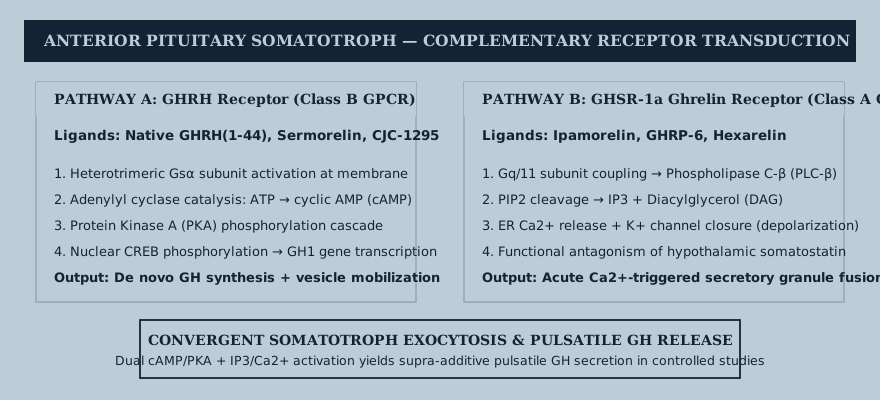
CJC-1295 exerts its biological effects through selective agonism of the growth hormone-releasing hormone receptor (GHRHR), a Class B secretin-family G-protein-coupled receptor expressed predominantly on somatotroph cells of the anterior pituitary gland. CJC-1295 binds to the large extracellular N-terminal domain with high affinity (Kd approximately 2–5 nM), inducing conformational changes that activate intracellular Gs proteins, adenylyl cyclase, and cyclic AMP (cAMP) accumulation. This second-messenger cascade activates protein kinase A (PKA), which phosphorylates transcription factors including CREB (cAMP response element-binding protein), upregulating growth hormone gene transcription and promoting Ca2+-dependent exocytosis of GH secretory granules.
Pituitary Somatotroph Selectivity
While GHRH receptors are expressed at low levels in extrapituitary tissues, the highest expression density occurs on anterior pituitary somatotrophs. Combined with restricted extravascular distribution from albumin binding, CJC-1295 administration increases mean 24-hour GH concentrations by 2- to 2.5-fold in healthy adults, with corresponding elevations in serum insulin-like growth factor-1 (IGF-1) (https://pubmed.ncbi.nlm.nih.gov/18648019/). This GHRHR mechanism contrasts with ghrelin-receptor secretagogues such as hexarelin.
Mechanistic Basis for GHRH–GHRP Synergy
Growth hormone-releasing peptides (GHRPs), including GHRP-2, GHRP-6, ipamorelin, and hexarelin, function as agonists of the growth hormone secretagogue receptor (GHSR or ghrelin receptor). While GHRH analogs activate the cAMP–PKA pathway, GHSR activation engages phospholipase C (PLC), generating inositol triphosphate (IP3) and diacylglycerol (DAG), which drive intracellular calcium mobilization and protein kinase C (PKC) activation (https://pubmed.ncbi.nlm.nih.gov/9467542/). Additionally, GHRPs suppress hypothalamic somatostatin tone, removing tonic inhibition of somatotrophs. In clinical endocrine studies, combining a GHRH analog with a GHRP can increase peak GH concentrations by 400%–800% compared to baseline, exceeding the 100%–200% increase observed with either class alone. See our Multi-Peptide Co-Administration & Receptor Cross-Talk explainer for further receptor analysis.
6. Published Trial Dose Ranges & Biomarker Interpretation
Published Clinical Trial Dose Ranges
Published clinical studies have evaluated CJC-1295 doses ranging from 30 mcg/kg to 120 mcg/kg administered as single subcutaneous doses or in repeated weekly research protocols (https://pubmed.ncbi.nlm.nih.gov/22450889/). For handling science, see our Trial Dosing & Prescriber Context and Storage & Stability Science guides.
IGF-1 Measurement & Metabolic Parameters in Research
In clinical endocrine studies, insulin-like growth factor-1 (IGF-1) serves as the primary biomarker for assessing integrated downstream GH secretion because serum IGF-1 exhibits far less hour-to-hour pulsatility than growth hormone itself (https://pubmed.ncbi.nlm.nih.gov/16352683/). In published trials, IGF-1 elevation above baseline manifests within 2–3 weeks of CJC-1295 administration and reaches steady-state concentrations after 4–6 weeks, with interpretation dependent on age-adjusted laboratory reference ranges.
GH-related safety and metabolic considerations include insulin sensitivity, lipid metabolism, thyroid function, blood pressure, fluid retention, and body-composition changes. Related considerations are discussed in our BPC-157 and TB-500 profiles.
7. Adverse Effect Profile, Safety Considerations & Regulatory Status
Adverse Reactions Reported in Clinical Trials
In clinical trials evaluating CJC-1295, reported adverse effects were generally mild to moderate and dose-dependent (https://pubmed.ncbi.nlm.nih.gov/15328142/):
- Injection-Site Reactions (~20%–30% of subjects): Transient local erythema, pruritus, and mild pain at the subcutaneous administration site.
- Vasomotor Flushing & Headache (10%–15% of subjects): Acute vascular tone or histamine-mediated symptoms typically resolving within 24–48 hours of administration.
- Fluid Retention & Transient Arthralgias (5%–10% of subjects): Dose-dependent sodium-retaining and connective-tissue effects associated with elevated GH and IGF-1.
Theoretical Long-Term Risks & Contraindications
Long-term safety of sustained GH and IGF-1 elevation via CJC-1295 remains incompletely characterized. Theoretical concerns include acromegalic soft-tissue changes with chronic supraphysiologic exposure, impaired glucose tolerance or insulin resistance in pre-diabetic or diabetic populations, and mitogenic stimulation of subclinical malignancies via the GH/IGF-1 axis. Standard clinical trial exclusions and contraindications include active malignancy, proliferative diabetic retinopathy, critical illness, uncontrolled diabetes mellitus, and severe cardiovascular disease.
FDA & WADA Regulatory Status (Current as of April 22, 2026)
- Unapproved New Drug Status: CJC-1295 is not approved by the U.S. Food and Drug Administration (FDA) or the European Medicines Agency (EMA) for any therapeutic indication and is classified as an unapproved investigational substance.
- FDA Bulk Drug Substances Page (as of April 22, 2026): FDA's page current as of April 22, 2026 lists CJC-1295 as nominated but withdrawn. Withdrawal of a nomination does not constitute FDA approval, safety clearance, or authorization for clinical compounding.
- WADA Prohibited List: CJC-1295 is prohibited at all times by the World Anti-Doping Agency (WADA) and sports organizations as a growth hormone-releasing factor (https://pubmed.ncbi.nlm.nih.gov/22450889/).
8. Research Applications and Second-Generation GHRH Analogs
Growth Hormone Deficiency & Somatopause Research
In endocrine research on adult growth hormone deficiency (AGHD) and GHRH deficiency models, CJC-1295 has been studied as a mechanism for stimulating endogenous pulsatile GH secretion from functioning somatotrophs rather than replacing GH exogenously via daily recombinant human growth hormone (rhGH) injections (https://pubmed.ncbi.nlm.nih.gov/18648019/). Investigational protocols have also explored the age-related decline in GH secretion (somatopause), HIV-associated lipodystrophy, cachexia syndromes, and recovery from catabolic or traumatic injury alongside tissue-repair peptides such as TB-500 and BPC-157 (PMID 19401417), though long-term randomized controlled trials are required to establish clinical efficacy and safety.
Alternative Half-Life Extension & Delivery Technologies
Beyond DAC maleimide–albumin bioconjugation, second-generation GHRH analog research evaluates alternative half-life extension strategies including polyethylene glycol conjugation (PEGylation), immunoglobulin Fc fusion proteins leveraging FcRn recycling, and non-carrier steric amino acid modifications. Investigational delivery systems include biodegradable microsphere depot encapsulation, subcutaneous implants, transdermal systems, and nanoparticle or permeation-enhanced oral formulations, parallel to broader metabolic peptide research involving compounds such as AOD-9604 (https://pubmed.ncbi.nlm.nih.gov/16352680/).
9. Peer-Reviewed References
- https://pubmed.ncbi.nlm.nih.gov/16352683/ (Source link) (Source link) (Source link) (Source link)
- https://pubmed.ncbi.nlm.nih.gov/15328142/
- https://pubmed.ncbi.nlm.nih.gov/22450889/ (Source link)
- https://pubmed.ncbi.nlm.nih.gov/16352680/ (Source link)
- https://pubmed.ncbi.nlm.nih.gov/18648019/
- https://pubmed.ncbi.nlm.nih.gov/9467542/
- Somatopause, growth hormone axis modulation, and metabolic/regenerative research review. https://pubmed.ncbi.nlm.nih.gov/19401417/