
1. Introduction & Molecular Pharmacology of the Gastric Pentadecapeptide
BPC-157 (Body Protection Compound-157), also designated PL-14736, is a stable gastric pentadecapeptide consisting of 15 amino acids with the sequence Gly-Glu-Pro-Pro-Pro-Gly-Lys-Pro-Ala-Asp-Asp-Ala-Gly-Leu-Val. Originally modeled on a protective protein fraction isolated from human gastric juice, this synthetic derivative has been evaluated for cytoprotective and tissue repair properties across multiple organ systems in preclinical research. Its designation as a "body protection compound" reflects pleiotropic effects observed in experimental models of tissue injury, inflammatory disorders, and organ damage.
Unlike many linear peptides that undergo rapid enzymatic cleavage in acidic digestive fluid, BPC-157 exhibits notable stability in gastric juice and demonstrates biological activity at microgram to nanogram doses in animal models. The compound has been investigated across 544 scientific articles published between 1993 and 2024, with 36 studies in a 2024 orthopedic systematic review examining its effects on musculoskeletal healing, gastrointestinal protection, and neurovascular repair. While studied predominantly in preclinical models, BPC-157's preclinical findings in tissue repair research warrant detailed examination of its cellular pathways, pharmacokinetic properties, and translational limitations.
| Compound Parameter | Published Property |
|---|---|
| Primary Amino Acid Sequence | Gly-Glu-Pro-Pro-Pro-Gly-Lys-Pro-Ala-Asp-Asp-Ala-Gly-Leu-Val (15 residues) |
| Research Designation | PL-14736 (Body Protection Compound-157) |
| Molecular Weight | Not published |
| Physiological Stability Profile | Resistant to degradation in human gastric juice; active across subcutaneous, intramuscular, intraperitoneal, and oral routes in animal models |
| Preclinical Elimination Half-Life | < 30 minutes in plasma (rats and beagle dogs), with urinary metabolite detection up to 4 days by mass spectrometry |
| Intramuscular Bioavailability (Animal) | 14%–19% in rats; 45%–51% in beagle dogs |
Receptor Interactions and Molecular Targets
Unlike pharmacological agents with a single cloned membrane receptor target, BPC-157 functions across multiple cellular pathways and molecular interactions. Current research has not identified a single dedicated membrane receptor exclusively responsible for BPC-157's effects, indicating that the peptide interacts with several intracellular signaling systems.
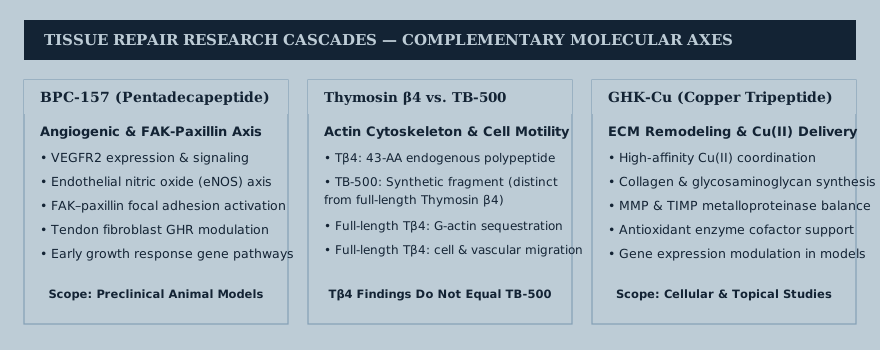
Published evidence indicates that BPC-157 influences the FAK–paxillin pathway involved in cell migration, the VEGFR2–Akt–eNOS pathway mediating angiogenesis, and the JAK2 pathway downstream of growth hormone receptor activation. In preclinical gene-expression studies, the peptide modulates expression of Egr, Nos, Srf, Vegr, Akt1, Plcγ, and Kras genes, which collectively regulate cell growth, proliferation, survival, and vascular development. This multi-pathway profile in tissue repair and cellular protection distinguishes it from single-target agents across experimental injury models.
2. Mechanism of Action at the Cellular Level
Angiogenic Pathway Activation (VEGFR2–Akt–eNOS & Src–Caveolin-1)
One of the most extensively characterized mechanisms of BPC-157 involves its pro-angiogenic effects mediated through the vascular endothelial growth factor receptor 2 (VEGFR2) signaling system. BPC-157 upregulates VEGFR2 expression in vascular endothelial cells and promotes receptor internalization through endocytosis-dependent mechanisms. Studies using dynasore, an endocytosis inhibitor, demonstrate that blocking receptor internalization prevents BPC-157's angiogenic effects, confirming the importance of this pathway.
Following VEGFR2 upregulation and internalization, BPC-157 time-dependently activates the downstream VEGFR2–Akt–eNOS signaling cascade, increasing endothelial nitric oxide synthase (eNOS) activity to support vasodilation and neovascularization. Additionally, BPC-157 activates signaling pathways involving Src, caveolin-1 (Cav-1), and eNOS, while reducing protein–protein interaction between eNOS and Cav-1, thereby enhancing nitric oxide bioavailability.
In vivo angiogenesis studies demonstrate that BPC-157 promotes vessel formation in chorioallantoic membrane (CAM) assays and endothelial tube formation assays. In animal models of hindlimb ischemia, the peptide accelerates blood flow recovery and increases vessel number despite not directly increasing VEGF-A expression, indicating that it acts primarily through receptor sensitization rather than ligand upregulation. Notably, while BPC-157 promotes healing-associated angiogenesis in ischemic models, cell-culture research also indicates that it can inhibit tumor-promoting effects of VEGF signaling via the MAPK pathway in melanoma cell lines, suggesting context-dependent modulation of vascular growth.
Growth Hormone Receptor (GHR) & JAK2 Pathway Modulation
BPC-157 also modulates the growth hormone receptor (GHR) signaling system in musculoskeletal cells. Studies in tendon fibroblasts show that BPC-157 dose-dependently and time-dependently increases growth hormone receptor expression at both mRNA and protein levels, enhancing cellular responsiveness to growth hormone.
Downstream of growth hormone receptor activation, BPC-157 stimulates Janus kinase 2 (JAK2) in a time-dependent manner following growth hormone stimulation, indicating that the peptide primes tendon fibroblasts for enhanced growth factor responsiveness rather than directly activating the pathway in the absence of endogenous ligand. Functioning as a local cellular sensitizer to endogenous growth factors rather than as a direct growth factor itself, its activity remains coupled to physiological growth factor signaling upregulated during injury and repair.
Anti-Inflammatory and Cytoprotective Mechanisms
Beyond promoting angiogenesis and growth factor responsiveness, BPC-157 exerts direct anti-inflammatory and cytoprotective effects in cellular and animal models. The peptide reduces inflammatory cytokine expression across injury models, supporting resolution of acute inflammation without apparent global immunosuppression.
In vitro studies demonstrate that BPC-157 promotes survival of cells exposed to oxidative damage, toxic substances, and serum deprivation, accompanied by focal adhesion kinase (FAK) and paxillin phosphorylation supporting tendon fibroblast outgrowth and migration. The peptide also modulates nitric oxide (NO) system function and dopamine/glutamate/NO interactions, which appears bidirectional in animal models—supporting physiological eNOS signaling while limiting excessive or damaging NO production during inflammatory stress.
3. Preclinical & Clinical Evidence in Musculoskeletal Tissue Repair
Preclinical evidence documents BPC-157's effects on tendon, ligament, muscle, and bone healing in rodent models:
- Tendon Repair: In rat models of complete Achilles tendon transection, BPC-157 administration accelerated healing with improved functional outcomes, biomechanical strength, and histological organization compared to untreated controls. The peptide promoted tendon outgrowth from explants, enhanced tendon fibroblast migration in vitro, and increased cell survival under stress conditions.
- Ligament Healing: In rat medial collateral ligament (MCL) surgical injury models, studies reported functional, biomechanical, macroscopic, and histological improvements, with enhanced ligament strength and reduced healing time correlating with increased cellularity, collagen deposition, and tissue organization during remodeling.
- Muscle Injury Models: In rodent models of muscle crush injury, laceration, toxic damage, and denervation, BPC-157 accelerated functional recovery and reduced muscle atrophy, associated with local angiogenesis, satellite cell activation, and reduced acute inflammatory damage.
- Orthopedic Systematic Review Summary: A 2024 systematic review examining BPC-157 in orthopedic sports medicine identified 36 studies (35 preclinical, 1 clinical) investigating musculoskeletal healing. While the preclinical studies reported positive healing effects across soft tissue models, the review emphasized that the majority of studies utilized small rodent models and that efficacy in humans remains unconfirmed by adequately powered randomized clinical trials.
4. Gastrointestinal, Vascular & Neurological Research
Gastrointestinal Protection and Mucosal Healing
Given BPC-157's origin from gastric juice protein fractions, extensive rodent research has examined its gastrointestinal protective properties. Both intramuscular and intragastric administration reduced ulcer area and accelerated healing in experimental gastric ulcers induced by NSAIDs, alcohol, stress, and direct caustic injury. In rodent dose-response studies, BPC-157 at 800 ng/kg produced near-complete ulcer healing with thick granulation tissue formation, enhanced epithelial cell proliferation and migration over ulcer beds, and vascular ingrowth.
Beyond the stomach, rodent studies have investigated lesions across the esophagus (including lower esophageal sphincter pressure models in rats), duodenum, small intestine, colon, liver, and pancreas, as well as colon–colon anastomoses, colocutaneous fistulas, and inflammatory bowel disease models. Early Phase II clinical trials for inflammatory bowel disease reported wound-healing effects with no reported toxicity, but detailed results from those trials have not been published in peer-reviewed journals, limiting independent assessment of clinical efficacy. Related inflammatory tissue models are also discussed in our TB-500 monograph.
Vascular and Cardiac Models
In experimental cardiovascular models, BPC-157 modulates vasomotor tone via the Src–caveolin-1–eNOS pathway, lowering elevated blood pressure in hypertensive rat models while supporting pressure normalization in hypotensive states. In rodent ischemia–reperfusion and myocardial infarction models, BPC-157 reduced infarct size, preserved cardiac function, and reduced arrhythmias, while vascular injury models showed reduced pathological thrombus formation alongside preserved hemostasis. Clinical translation of these experimental cardiovascular findings requires confirmation in controlled human studies.
Neurological and Neuroprotective Models
In rodent central and peripheral nervous system models, BPC-157 reduced brain damage in experimental traumatic brain injury, stroke, and toxic insults, and preserved myelin integrity in cuprizone-induced demyelination models. In peripheral nerve crush and transection models in rats, the peptide promoted Schwann cell proliferation, axonal regrowth, and nerve conduction velocity recovery. Because animal neurological models differ substantially from human neurodegenerative and neuropathic diseases, these findings remain preclinical pending human validation.
5. Pharmacological Profile, ADME Characteristics & Experimental Parameters
Absorption and Distribution
Nonclinical pharmacokinetic studies in rats and beagle dogs demonstrate linear pharmacokinetics across tested doses. Following single administration, the plasma elimination half-life of prototype BPC-157 is less than 30 minutes in both species, indicating rapid systemic clearance. Mean absolute bioavailability following intramuscular injection was approximately 14%–19% in rats and 45%–51% in beagle dogs, reflecting route- and species-dependent absorption characteristics.
Distribution studies using radiolabeled [3H]BPC-157 demonstrate rapid and widespread tissue distribution following systemic administration, reaching peak plasma concentrations within 30 minutes and distributing to liver, kidney, gastrointestinal tract, and injured tissues. Extensive volume of distribution beyond the vascular compartment, combined with rapid plasma clearance, indicates that tissue binding or cellular uptake contributes to the disconnect between the peptide's short (<30-minute) plasma half-life and the prolonged biological effects observed with once- or twice-daily administration in animal studies.
Metabolism and Elimination
BPC-157 undergoes rapid metabolic degradation into smaller peptide fragments and ultimately single amino acids that enter normal amino acid metabolism. Tracking of radiolabeled [3H]BPC-157 demonstrates that the principal amino acid metabolite detected in plasma, urine, and feces is proline. Elimination occurs primarily via renal excretion of metabolites (with fecal elimination also contributing, particularly after oral administration), and intact peptide or fragments remain detectable in urine for up to 4 days by mass spectrometry despite plasma clearance within hours.
Experimental Dose Ranges & Translational Context
Preclinical studies have evaluated BPC-157 across a six-order-of-magnitude experimental range (10 ng/kg to 10 mg/kg) over 1- to 4-week rodent healing timelines or longer chronic disease models, including preclinical co-administration studies with growth hormone. Although allometric scaling and retrospective observational reports (including a single retrospective report in which 7 of 12 evaluated knee-injection respondents reported symptom changes lasting over six months) are frequently cited in clinical discussions, human pharmacokinetic parameters across age, renal or hepatic impairment, body composition, and concurrent cardiovascular or anti-inflammatory medications have not been established through formal human pharmacokinetic or drug-interaction trials. See our Trial Dosing & Prescriber Context explainer for a detailed review of why animal experimental regimens do not establish validated human dosing.
6. Safety Profile and Toxicological Considerations
Preclinical Safety Studies
Preclinical safety evaluations of BPC-157 across tested animal dose ranges (6 μg/kg to 20 mg/kg) and multiple administration routes (intramuscular, intraperitoneal, intravenous, and oral) did not identify an acute lethal dose; limit-test studies failed to establish an LD50. Subchronic and chronic toxicity studies in animals showed no treatment-related histopathological lesions in major organs (liver, kidney, heart, brain, and reproductive tissues) or clinical chemistry/hematology abnormalities. While rodent reproductive and teratogenicity assays reported no congenital abnormalities in offspring, preclinical animal findings do not establish safety during human pregnancy or lactation.
Human Clinical Safety Data & Limitations
Human safety data for BPC-157 remain sparse compared with the animal toxicology database:
- Unpublished Phase I & Phase II Trials: Early Phase II trials in inflammatory bowel disease reported no toxicity or severe adverse events, though detailed peer-reviewed safety datasets were not published. A Phase I safety trial of 42 healthy volunteers receiving oral BPC-157 was conducted in 2015, but results were never formally published following cancellation of the planned regulatory submission in 2016.
- Small Uncontrolled Human Reports: Published human experience is largely limited to a retrospective chart review of intra-articular knee injections noting no significant adverse events in 16 participants and a small study of intravenous BPC-157 for interstitial cystitis reporting no adverse effects in 12 treated patients. Small sample sizes, lack of placebo controls, and retrospective designs preclude definitive human safety conclusions.
- Long-Term & Theoretical Risks: Long-term human safety is undefined. Theoretical considerations include pro-angiogenic signaling in patients with active or subclinical malignancy and hemodynamic modulation of blood pressure or vascular tone in patients with cardiovascular disease or taking vasoactive medications.
7. Current Research Landscape, Systematic Review & Knowledge Gaps
The 2024 systematic review identified 544 articles published between 1993 and 2024, with 36 studies (35 preclinical animal studies and 1 clinical study) meeting inclusion criteria for orthopedic sports medicine analysis. This distribution highlights the substantial translational gap between extensive rodent research and limited human clinical validation.
Critical Translational Knowledge Gaps
Key limitations preventing evidence-based clinical conclusions include: (1) predominance of small rodent models with short follow-up windows relative to human tissue remodeling timelines; (2) absence of formal human dose-finding and human pharmacokinetic/pharmacodynamic (PK/PD) trials; (3) lack of multi-year human safety and oncological/cardiovascular surveillance; and (4) lack of multicenter, randomized, double-blind, placebo-controlled human clinical trials with validated structural and functional endpoints.
Ongoing laboratory research utilizes confocal microscopy, in vivo imaging, proteomics, and transcriptomics to characterize real-time cellular migration, angiogenesis, and gene-expression signatures, alongside comparative investigations with other signaling classes such as growth hormone secretagogues.
8. FDA & WADA Regulatory Status (Current as of April 22, 2026)
- Unapproved Drug Status: BPC-157 lacks approval from the U.S. Food and Drug Administration (FDA) or other major regulatory authorities for any human therapeutic indication.
- FDA Bulk Drug Substances Page (as of April 22, 2026): FDA's page current as of April 22, 2026 lists BPC-157 as nominated but withdrawn. Withdrawal of a nomination is an administrative action by the nominating party and does not constitute FDA approval, safety clearance, or permission for clinical compounding.
- WADA Prohibited List: The World Anti-Doping Agency (WADA) prohibits BPC-157 in competitive sports as a banned substance under prohibited peptides and growth factors (Section S0 / S2).
- Analytical Quality Control: In the absence of an official pharmacopoeial monograph, laboratory reference material should be verified through independent third-party Certificates of Analysis documenting HPLC purity, mass spectrometric identity, net peptide content, and endotoxin testing, as detailed in our Supplier Compendial Compliance Audit, Safety & Regulatory Framework, and Storage & Stability Science guides.
9. Key References
- Sikiric P, et al. Multifunctionality and Possible Medical Application of the BPC 157 Peptide—Literature and Patent Review. Pharmaceuticals. 2025;18(2):185. https://www.mdpi.com/1424-8247/18/2/185 (Source link) (Source link)
- Garza A, et al. Emerging Use of BPC-157 in Orthopaedic Sports Medicine: A Systematic Review. Cureus. 2024;16(8):e67459. https://pmc.ncbi.nlm.nih.gov/articles/PMC12313605/ (Source link) (Source link) (Source link) (Source link) (Source link) (Source link) (Source link) (Source link) (Source link)
- Chang CH, et al. The promoting effect of pentadecapeptide BPC 157 on tendon healing involves tendon outgrowth, cell survival, and cell migration. J Appl Physiol. 2011;110(3):774-780. https://pubmed.ncbi.nlm.nih.gov/21030672/ (Source link) (Source link)
- Krivic A, et al. Pentadecapeptide BPC 157 (PL 14736) improves ligament healing in the rat. J Orthop Res. 2010;28(9):1155-1161. https://pubmed.ncbi.nlm.nih.gov/20225319/ (Source link)
- Huang T, et al. Pentadecapeptide BPC 157 Enhances the Growth Hormone Receptor Expression in Tendon Fibroblasts. Molecules. 2018;23(11):2929. https://pmc.ncbi.nlm.nih.gov/articles/PMC6271067/ (Source link)
- Hsieh MJ, et al. Therapeutic potential of pro-angiogenic BPC157 is associated with VEGFR2 activation and up-regulation. J Mol Med. 2017;95(3):323-333. https://pubmed.ncbi.nlm.nih.gov/27847966/ (Source link) (Source link)
- Park JM, et al. Pharmacokinetics, distribution, metabolism, and excretion of body-protective compound 157, a potential drug for treating various wounds, in rats and dogs. Front Pharmacol. 2022;13:1026182. https://pmc.ncbi.nlm.nih.gov/articles/PMC9794587/ (Source link) (Source link) (Source link) (Source link) (Source link) (Source link)
- Sikiric P, et al. Stable gastric pentadecapeptide BPC 157: novel therapy in gastrointestinal tract. Curr Pharm Des. 2011;17(16):1612-1632. https://pubmed.ncbi.nlm.nih.gov/21548867/ (Source link) (Source link) (Source link)
- Seiwerth S, et al. Stable Gastric Pentadecapeptide BPC 157 and Wound Healing. Front Pharmacol. 2021;12:627533. https://www.frontiersin.org/journals/pharmacology/articles/10.3389/fphar.2021.627533/full (Source link) (Source link)
- Staresinic M, et al. Gastric pentadecapeptide body protection compound BPC 157 and its role in accelerating musculoskeletal soft tissue healing. Cell Tissue Res. 2019;377(2):153-159. https://pubmed.ncbi.nlm.nih.gov/30915550/ (Source link) (Source link) (Source link)
- Sikiric P, et al. Focus on ulcerative colitis: stable gastric pentadecapeptide BPC 157. Curr Med Chem. 2012;19(1):126-132. https://pubmed.ncbi.nlm.nih.gov/22300085/ (Source link) (Source link) (Source link)
- Vukojevic J, et al. Pentadecapeptide BPC 157 and the central nervous system. Curr Neuropharmacol. 2022;20(2):528-543. https://pmc.ncbi.nlm.nih.gov/articles/PMC8504390/ (Source link)